
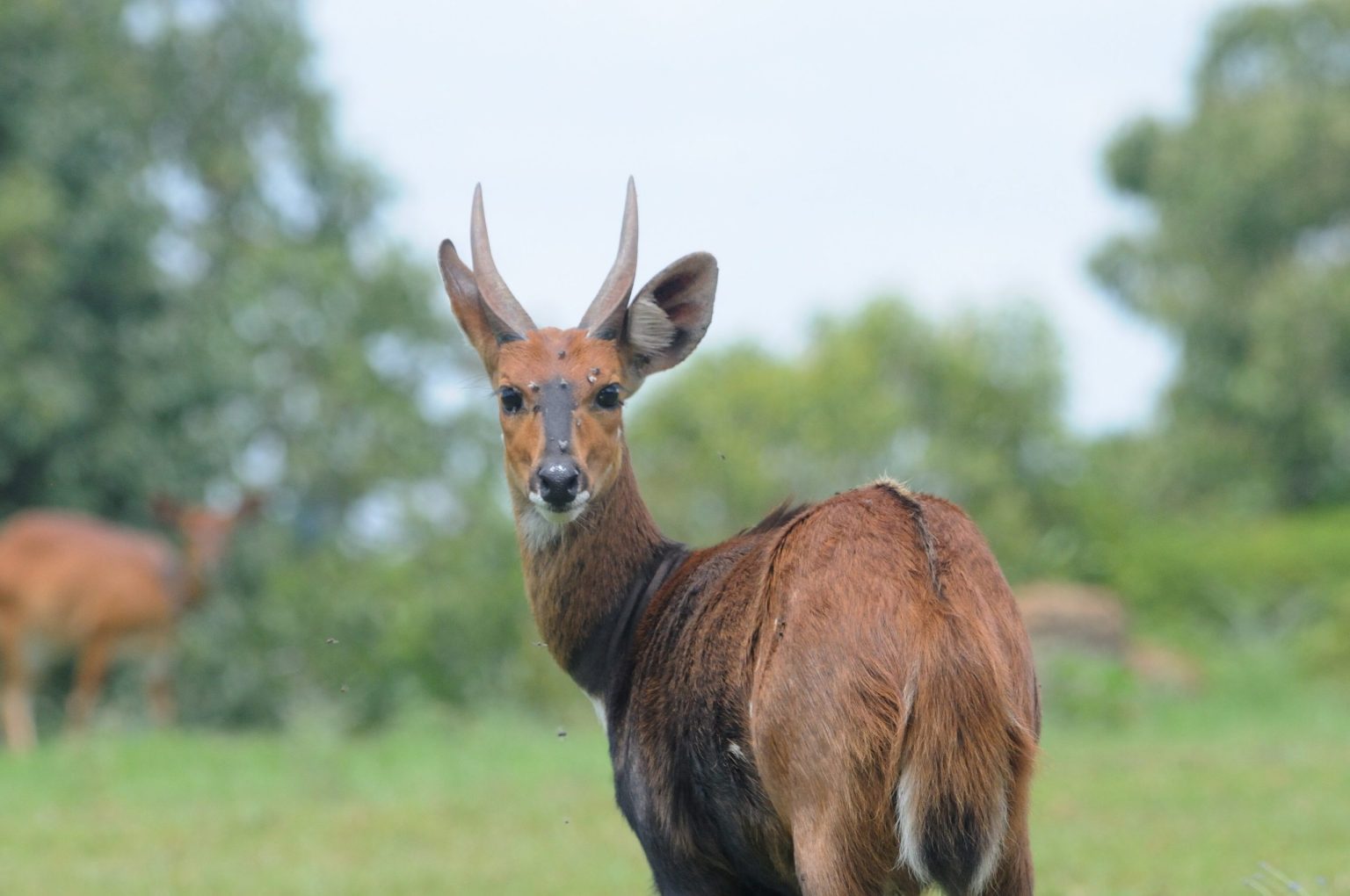
Mount Elgon wildlife includes forest elephants, buffalo, several monkey species, duikers, bushpig, small mammals, and more than three hundred recorded bird species, but this is not a classic big game safari park. Wildlife is spread through thick forest and high mountain habitat, so sightings are less predictable than on open savanna. Mount Elgon National Park protects the Ugandan slopes above Mbale and the Elgon highlands.
What Wildlife Can You See on a Mount Elgon Safari
A Mount Elgon wildlife safari is mainly a walking and birding experience. The forest is dense, the terrain is steep, and many mammals are shy. Uganda Wildlife Authority notes that large mammals such as elephant and buffalo live in the park but are rarely seen.
That reality should shape expectations. Do not arrive expecting lines of vehicles around a buffalo herd or elephants standing beside an open track. Much of the interest comes from signs, calls, quick movement through trees, bird activity, and the change in habitat as the trail climbs.
Wildlife reality: Mount Elgon rewards slow observation. If your main goal is guaranteed large mammal viewing, pair the mountain with a savanna reserve rather than judging Elgon by game drive standards.
The park is valuable precisely because it protects mountain forest, bamboo, heath, moorland, streams, caves, and high altitude plant communities that do not resemble Uganda’s open grassland parks.
Forest Elephants on Mount Elgon
Forest elephants occur on Mount Elgon, although seeing one on the Ugandan side is unusual. UWA includes Mount Elgon among Uganda’s forest elephant areas. In thick vegetation, hikers are more likely to notice tracks, broken vegetation, dung, or other signs than to stand close to an elephant.
Elephants should never be approached on foot. If a ranger finds fresh sign, follow instructions and give the animal space. Dense forest can hide a large animal until the distance is short.
Mount Elgon is also famous more broadly for elephants using mineral rich caves on the mountain system. The best known cave elephant stories come from the Kenyan side, where elephants have entered caves to reach salts. Travellers should not assume that a cave visit in Uganda means they will see this behaviour.
The useful takeaway is simple: elephants are part of the Elgon ecosystem, but they are not a dependable tourist sighting.
Buffalo and Other Large Mount Elgon Mammals
African buffalo live in Mount Elgon forest and are also difficult to see. Their presence matters for hiking safety because a hidden buffalo at close range is very different from watching a herd from a vehicle.
Stay with the ranger on park trails. Do not push into thick vegetation to improve a photograph or follow fresh animal sign on your own. A ranger understands where the path allows safe movement and when the group should wait.
Leopard is listed in UWA’s Mount Elgon management records, but a tourist sighting is very unlikely. Bushpig and duiker are more realistic members of the mammal community, though even these can disappear quickly in forest.
Sighting note: a quiet early walk usually gives you a better chance of hearing and noticing wildlife than a noisy group rushing toward a viewpoint.
Monkeys on a Mount Elgon Forest Walk
Mount Elgon supports several primates. UWA management records include black and white colobus, blue monkey, and de Brazza’s monkey. Lower forest routes are the most practical place for a visitor to look for primates because there is more tree cover and you can move slowly.
Black and white colobus are easier to identify when they move through the canopy because of their strong colour pattern and long tail. Blue monkeys can be harder to pick out inside leaves and branches. De Brazza’s monkey is quieter and more secretive.
Listen before looking. Branch movement, alarm calls, feeding sounds, and a guide pointing to a gap in the canopy can reveal animals you would walk straight past alone.
Do not feed monkeys. Food changes animal behaviour and can draw them toward people or buildings.
Bird Watching on Mount Elgon
Birding is the strongest wildlife activity on Mount Elgon. Uganda Wildlife Authority records more than three hundred bird species in the park. The list includes African goshawk, Chubb’s cisticola, white chinned prinia, African blue flycatcher, and the lammergeier.
Different elevations produce different birding. Lower forest and edge habitat can be active early in the morning. Bamboo and montane forest bring another set of species, while upper moorland changes both the vegetation and the birds you are searching for.
A birding tour should move slower than a normal day hike. Tell the guide you care about birds so the group does not walk past calls and mixed feeding flocks. Binoculars matter more here than a long camera lens carried only for large mammals.
Weather can close down activity for a while. Rain and wind make forest birding harder, then activity can restart when conditions settle.
Small Mammals and Lesser Seen Mount Elgon Wildlife
The Mount Elgon mammal list is much larger than the few animals most travel pages name. UWA’s management plan records bats, squirrels, rats, mice, mole rats, and other small mammals. Most are not animals a casual visitor will identify during a daytime trek.
The Mount Elgon mole rat is one example of a species tied closely to the mountain system. Small mammals form part of the food web even when visitors never see them. Their presence supports predators and shows how many habitat types exist across the altitude range.
Night activity is also easy to miss because standard tourist walks happen in daylight. Bats leave roosts after dark, while bushpig and some smaller mammals become more active when hikers are already at camp.
Do not turn a trek into an off trail search for small wildlife. Stay on the designated route and let sightings happen from normal visitor areas.
Mount Elgon Wildlife Changes With Altitude
One reason the park has a broad wildlife list is the change in vegetation from lower montane forest through bamboo and higher open zones. A summit trek passes through habitats that feel increasingly different as the group climbs.
Lower forest offers the best chance for monkeys and many forest birds. Bamboo can hold its own bird and mammal signs. Higher moorland has less closed tree cover and brings giant lobelias, groundsels, grass, heath, and cold wet ground.
Large mammals do not conveniently appear at a fixed altitude for tourists. Food, water, human disturbance, season, and daily movement all matter. Ask the ranger what has been seen recently rather than relying on a generic wildlife checklist.
Habitat check: look at the plants as carefully as the animals. On Mount Elgon, the changing vegetation is part of the wildlife story and explains why species occur where they do.
Best Mount Elgon Trails for Wildlife and Birding
Lower forest walks around Kapkwai are a strong choice for travellers whose main goal is wildlife rather than Wagagai. You can spend more time in productive forest and avoid the pressure of making a distant camp by a set hour.
The Sipi route also passes through substantial forest before climbing higher. Piswa is known for podocarpus forest and gives another route through wildlife habitat. Sasa crosses bamboo after its steep lower climb and is often chosen for speed toward the summit rather than for slow wildlife observation.
If birding is the priority, ask for a day walk or a private paced trek. Joining a fast summit group can leave little time to stop for calls in the canopy.
For photography, protect equipment from rain and condensation. A camera inside a dry bag is more useful than a larger camera that spends the afternoon wet.
How to Improve Your Mount Elgon Wildlife Sightings
Walk quietly. Keep the group compact. Let the guide stop without filling every pause with conversation. Many forest sightings last seconds.
Start early where possible. Morning temperatures are comfortable for walking and bird activity can be better before the day warms. Carry binoculars even if you are not a dedicated birder. They are useful for monkeys and distant movement too.
Wear clothing that handles rain and mud. The goal is not camouflage fashion. It is staying comfortable enough to stand still when the guide finds something.
Manage expectations around elephants, buffalo, and leopard. A trip can be very good without seeing any of them. Forest monkeys, birds, tracks, plants, waterfalls, and the upper mountain can still make the day worthwhile.
Combining Mount Elgon Wildlife With a Uganda Safari
Mount Elgon complements Uganda’s savanna parks rather than replacing them. Use Elgon for walking, birds, highland forest, coffee country, and mountain time. Use places such as Pian Upe, Kidepo, Murchison, Queen Elizabeth, or Lake Mburo when open country game viewing is the main goal.
Pian Upe is especially useful in an eastern Uganda route because it lies beyond the Elgon area toward Karamoja and offers a very different wildlife setting. Travellers can move from mountain forest to open reserve country without crossing the whole country.
A balanced eastern trip might use Mbale as the first base, add Mount Elgon or Sipi, then continue north toward Pian Upe and Karamoja. The exact order depends on road time and how much hiking you want before game drives.
Mount Elgon Wildlife FAQ
What animals live in Mount Elgon National Park?
UWA records African elephant, African buffalo, black and white colobus, blue monkey, de Brazza’s monkey, bushpig, duiker, leopard, bats, squirrels, rodents, and other mammals in the park.
Will I see elephants on Mount Elgon?
Possibly, but do not plan around it. UWA states that elephants and buffalo occur in the forest and are rarely seen. Tracks and other signs are more common than a clear sighting.
How many bird species are found on Mount Elgon?
Uganda Wildlife Authority states that the national park has more than 300 bird species, making birding one of the most dependable wildlife activities on the mountain.
How much is entry to Mount Elgon National Park?
UWA currently displays adult park entry at USD 35 for foreign non residents, USD 25 for foreign residents, and UGX 15,000 for East African citizens. Confirm the rate before travel.
Is Mount Elgon good for a traditional game safari?
No. The park is better for walking, birding, primates, forest ecology, and mountain habitat. Large mammals are present but are harder to see than in open savanna parks.
Where should I stay for Mount Elgon wildlife walks?
Mbale works well for a city base, while Sipi gives easy access to the Kapkwai side. Choose according to the trail and other activities you want to combine with the wildlife walk.
Return to Mbale After Your Mount Elgon Walk
Mount Elgon Hotel and Spa gives wildlife walkers and hikers a comfortable Mbale base with rooms, Masaaba Restaurant, gardens, and Kwetu Spa. Use the hotel before a forest day or summit trek, then return to Mbale after the mountain instead of adding another long road transfer to tired legs. Contact the hotel with your dates and preferred Elgon activity.